
Why this blog?
I started digging about information regarding iron infusions as more and more patients seemed to be opting for infusions and then also getting reactions to them. I had known about the risk of low phosphate with iron infusions for a while and when able, patients and I would put together preventative strategies but when I went digging I was surprised how much other information came up – hence the reason I thought I would write this.
Background
About 1 in 20 Australian women of reproductive age receive IV iron and prescribing has risen about 17-fold from 2013 to 2024 (i). This was my first surprise when I started digging around. I mean, I knew there was a lot more infusion being prescribed but was surprised how MUCH more.
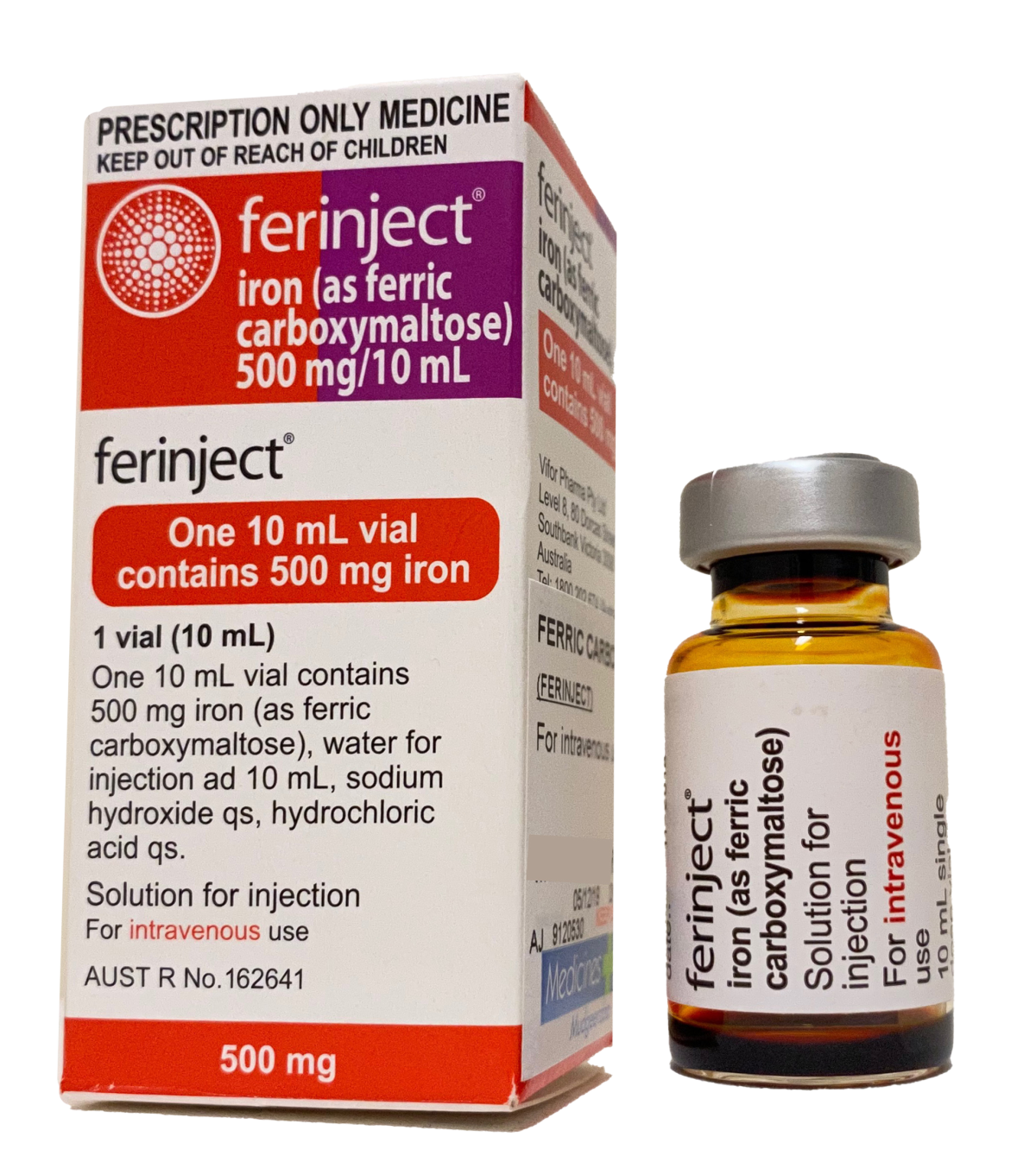
In Australia, the most common type of iron infusion is ferric carboxymaltose – brand name Ferinject. It makes up about 98% of IV iron prescribing in Australia. The interesting thing about ferric carboxymaltose is that the FDA in America have just issued the requirement for a black box warning for the risk of hypophosphatemia (low levels of phosphate in the blood) associated with ferric carboxymaltose infusionii (Ferinject) (ii). There had been a warning label regarding this since 2020, so I found it interesting that it was upgraded to a black box warning – why the upgrade? I dug further…..
Hypophosphatemia (low phosphate)
Clinical signs of low phosphate are; Muscle weakness, fatigue, bone pain, pseudo-fractures and osteomalacia (softening of bone)
Interesting because these are incredibly similar to iron deficient anaemia signs, right? How many iron deficient people ended up with undiscovered low phosphate post infusion and just thought it was part of the low iron picture? You can only find low phosphate if you screen for electrolytes in blood pathology and in my experience, it is often only iron studies that are retested post infusion – unless there are super obvious and more extreme symptoms post infusion.
We are led to believe that low phosphate post infusion only occurs in a smaller percentage of people and is transient but researcher Heinz Zoller, who authored a paper regarding fracture risk and ferric carboxymaltose infusions (more on that later!), quotes a study that puts the number is closer to 50 – 70% of all patients receiving ferric carboxymaltose (Ferinject) infusions with severe and persistent low phosphate in about 11% (iii iv).
In clinic we try to offset this with supplements; NAC, bioactivated calcium with Vit D and electrolyte use but it is far from perfect in its ability to prevent low phosphate levels post infusions.
The link to fracture risk
What is incredibly interesting is that the retrospective research conducted by Heinz Zoller and published only a few months ago, showed that ferric carboxymaltose (Ferinject) infusions not only were associated with a high risk of causing low phosphate, but they were also actually related to increased (3-fold) risk of bone events (like fracture), even just with one infusion. This was a cohort of 357 people, so they accessed a US data base to see if the results were the same – in a group size of over 20000 they also found similar (v).
Given that one of the long-term side effects of iron deficient anaemia is loss of bone AND as mentioned a side effect of low phosphate is loss of bone could this result be simply related to either or both of these things?
The researchers dug further into mice modelling which suggested that ferric carboxymaltose seemed to be taken up by the osteoblasts (bone forming cell) and reduced bone formation, so, an independent mechanism.
With this new information, I do find it incredibly disturbing then that 1 in 20 Australian women (because that’s the stats of infusions) might be at greater risk of bone loss.
What is the alternative?
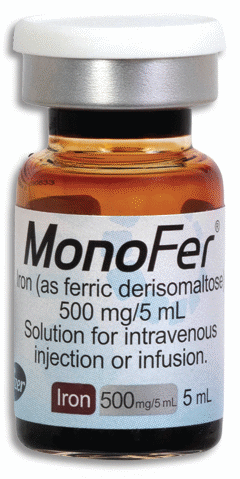
There is another iron infusion that is available in Australia, ferric derisomaltose, brand name Monofer, that has a significantly less risk for causing low phosphate and significantly less association with bone events. It can also be infused at the same rate as Ferinject and can dosed high enough, so it is only the one infusion still required.
Why isn’t it being used? Well, the more definitive information about the true scope of Ferinject causing low phosphate and association with bone events only came to light this year plus, and (this is a BIG one), ferric carboxymaltose came off patent this year so that means its now about a third of the price of ferric derismaltose, Monofer. Of course that means it is then more likely to be used, especially in a public setting.
What can you do?
If you are a private patient looking at an iron infusion then ask your Dr about ferric derisomaltose, Monofer, instead of ferric carboxymaltose, Ferinject. Certainly if you are pregnant and are absolutely requiring an iron infusion (which can be warranted if iron is low enough as low iron confers other risks to mum and bub) then try to push for ferric derisomaltose, Monofer. Better still, before pregnancy make sure that you don’t just have “enough” iron, you need to have really robust levels, so you lessen the chance of needed an infusion in pregnancy.
If you cannot avoid a ferric carboxymaltose, Ferinject infusion then try to get phosphate and Vit D levels checked beforehand as lower levels of these before infusion might place you at greater risk of low phosphate.
The podcast mentioned below (iii) was an interview between Prof Heinz Zoller (the researcher) and Prof Ian Morison, a haematologist from University Otago NZ, Assoc Prof Luke Grzeskowiak, clinical pharmacist Flinders University and host Mic Cavazzini for the Royal Australasian College of Physicians. These are specialists in their field, not just your average Joe. And by all means, if needed, direct your GP to this episode if they would like to learn more.
Hope this helps legends.
Wendy.
(ps. Proudly written by this human and not AI generated so forgive spelling or grammar errors, lol)
References
- Kassie, Grzeskowiak, et al. Increasing utilisation of intravenous iron among Australian women of reproductive age, 2013–2024. Intern Med J. 2026.
- US FDA. FDA adds boxed warning to labeling for ferric carboxymaltose injection (Injectafer) to describe risk of low phosphate levels.
- Cavazzini, M. (Host). (2026, October 1). Iron infusions and fracture risk (No. 158) [Audio podcast episode]. In Pomegranate Health. Royal Australasian College of Physicians. https://www.racp.edu.au/pomegranate/View/ep158-iron-infusions-and-fracture-risk
- Martens KL, Wolf M. Incidence, mechanism, and consequences of IV iron-induced hypophosphatemia. Hematol Am Soc Hematol Educ Program. 2023;2023(1):636–639
- Wagner, Zoller, et al. Ferric carboxymaltose increases fracture risk in patients and reduces bone formation in mice with iron deficiency anemia. Blood. 2026.